Wildlife North America . com North American Animals - mamals, birds, reptiles, insects |
Broad-banded Copperhead (Agkistrodon contortrix laticinctus)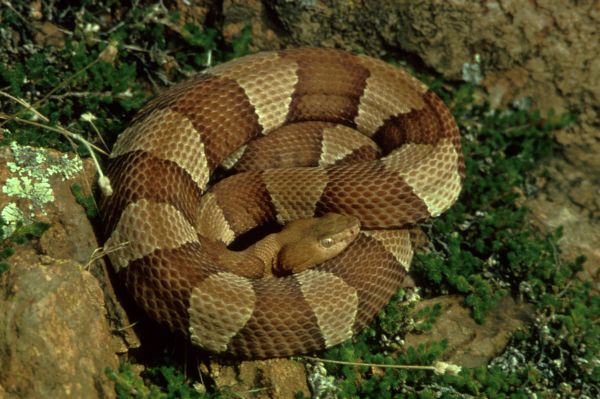
Broad-banded Copperhead Photograph by Ray Rauch, U.S. Fish and Wildlife Service. License: Public Domain. (view image details)
BROAD-BANDED COPPERHEAD FACTS
DescriptionThe Broad-banded Copperhead is light tan with broad reddish-brown or copper bands with a very thin white border. The number of bands varies from 10 to 17. It has a large head and hinged fangs that spring out when striking at prey or in defence. Young are usually much lighter in color with greenish yellow tips to their tails. Size length 50cm - 75cm Environment forest, woodland, where it may be found amongst the cover of fallen branches, dried leaves, pine needles Food small rodents, ground birds, lizards, large insects, frogs and other small snakes Breeding live bearing with litters from three to ten young. The newborn snakes are left to fend for themselves and have fully developed senses and venom. Range central Texas, Oklahoma to south Kansas. Notes Bites to humans are very uncommon. Symptoms of bites include intense pain, tingling, throbbing, swelling, and severe nausea. Bite can cause muscle damage. Seek immediate medical attention if bitten. Classification
Relatives in same Genus Common Cantil (A. bilineatus bilineatus) Ornate Cantil (A. bilineatus taylori) Southern Copperhead (A. contortrix contortrix) Northern Copperhead (A. contortrix mokasen) Osage Copperhead (A. contortrix phaeogaster) Trans-pecos Copperhead (A. contortrix pictigaster) Florida Cottonmouth (A. piscivorus conanti) Western Cottonmouth (A. piscivorus leucostoma) Eastern Cottonmouth (A. piscivorus piscivorus) Home | Mammals | Reptiles | Birds | Insects | Privacy Policy | Disclaimer | Contact Us |