Wildlife North America . com North American Animals - mamals, birds, reptiles, insects |
Osage Copperhead (Agkistrodon contortrix phaeogaster)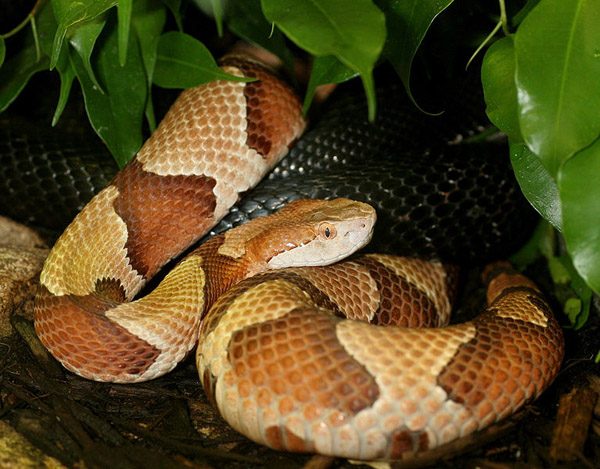
Osage Copperhead (Agkistrodon contortrix phaeogaster) The black snake in the background is a Black Rat Snake. Photograph by Tad Arensmeier. Some rights reserved. (view image details)
OSAGE COPPERHEAD FACTS
DescriptionThe Osage Copperhead has dark chestnut cross bands that are narrower in the center and wider on the sides, giving the bands an hourglass shape. There are also dark rounded spots at the sides of the belly. The head is a copper-red color. Young snakes are lighter in color with a yellow tail tip and a narrow dark line through the eye. The color pattern is similar to that of A. contortrix mokasen except that the dark bands are in sharper contrast to the background, and there are no dark spots between the bands. Size length 70cm - 100cm Environment found amongst leaf litter, logs and branches. Food small rodents, ground birds, lizards, large insects, frogs and other small snakes Breeding live bearing with litters from three to ten young. The newborn snakes are left to fend for themselves and have fully developed senses and venom. Range The United States, in eastern Kansas, extreme southeastern Nebraska and a large part of Missouri. Notes Bites to humans are very uncommon. Symptoms of bites include intense pain, tingling, throbbing, swelling, and severe nausea. Bite can cause muscle damage. Seek immediate medical attention if bitten. Classification
Relatives in same Genus Common Cantil (A. bilineatus bilineatus) Ornate Cantil (A. bilineatus taylori) Southern Copperhead (A. contortrix contortrix) Broad-banded Copperhead (A. contortrix laticinctus) Northern Copperhead (A. contortrix mokasen) Trans-pecos Copperhead (A. contortrix pictigaster) Florida Cottonmouth (A. piscivorus conanti) Western Cottonmouth (A. piscivorus leucostoma) Eastern Cottonmouth (A. piscivorus piscivorus) Home | Mammals | Reptiles | Birds | Insects | Privacy Policy | Disclaimer | Contact Us |